Building Alternatives: THE European Left in Mexico
STATEMENT OF EUROPEAN LEFT CON ARTICLE OF ANNA CAMPODSAMOPIERO
The European Left at the 30th INTERNATIONAL SEMINAR of the Partido del Trabajo (PT) in MEXICO CITY: BUILDING AN ALTERNATIVE BASED ON PEACE, SOCIAL JUSTICE AND INTERNATIONALIST SOLIDARITY
A delegation from the Party of the European Left, comprising Marta Martin Moran, Vice-President and Head of International Relations, David Pestieau, Vice-President, Anna Camposampiero and Valentina Škafar from the Political Secretariat, Manu Pineda, from the Executive Board, and Cristina Simò, coordinator of the Feminist Assembly of the European Forum, took part in the 30th International Seminar ‘Los Partidos y una Nueva Sociedad’, organised by the Mexican Partido del Trabajo from 8 to 10 October in Mexico City. Also present was José Luis Centella, president of the PCE.
The seminar serves as a forum for political debate amongst left-wing movements from around the world on the transformations of the international order and the prospects for an alternative to capitalism, war and the new right-wing movements. For thirty years, parties, organisations and representatives of the international left have been coming together to discuss the transformations of the contemporary world and to forge common paths for political action. The 2026 edition was naturally dedicated to the centenary of the birth of Fidel Castro Ruz and his legacy in these difficult times.
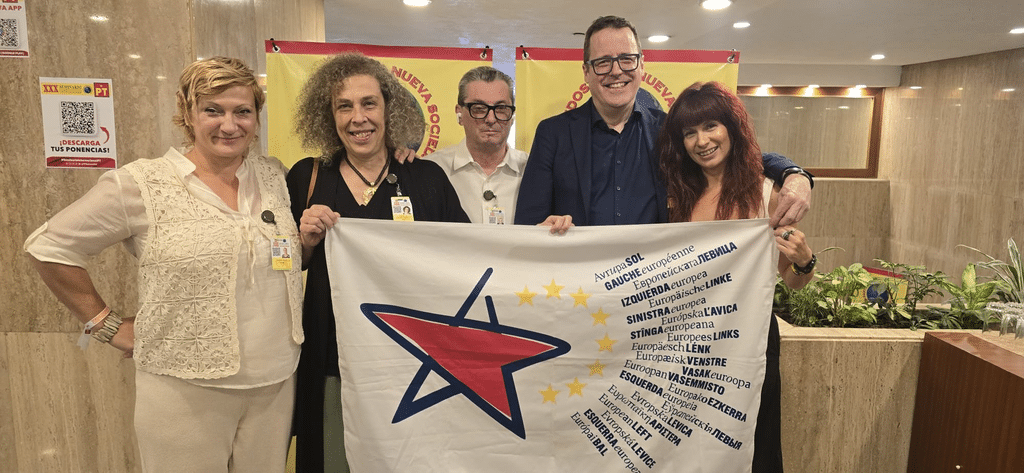
The 2026 edition brought together 269 international delegates, representing 101 parties and organisations from 36 countries, making Mexico City a meeting point for political experiences from different continents.
The presence of delegations from Latin America and the Caribbean, Europe, Africa and Asia enabled a comparison of different perspectives on geopolitical transformations, on the challenges posed by the rise of the far right and neo-fascism, and on the need to strengthen international cooperation for peace, the sovereignty of peoples and social justice.
All the speeches by members of the European Left highlighted the risks posed by a Europe that is rearming at the expense of social spending, that applies double standards, and that fails to promote dialogue and peace. The Party of the European Left proclaims itself the party of peace, calls for a return to the spirit of Helsinki, and has declared its full support for all the protests being organised across every European country, ranging from trade union strikes to the major youth protest on 20 November against the reinstatement of compulsory military service and the prospect of young people being sent to fight a war they do not wish to fight.
There was immense recognition for Alberto Anaya Gutiérrez, founder and long-standing leader of Mexico’s Partido del Trabajo (PT), a champion of dialogue and cooperation between the left in Latin America and around the world, and of the Seminar.
At the heart of the proceedings was an analysis of shifts in the geopolitical balance of power, the emergence of new political-military and economic blocs, and the role of Latin America and the Caribbean in building a multipolar international order. Considerable attention was also devoted to taking stock of the left’s experiences over the last thirty years, the struggle against colonialism, the crisis of capitalism, militarisation, and the need to forge agreements and initiatives for peace.
The seminar was opened by a lengthy and in-depth address by the former President of Colombia, Gustavo Petro, who touched on many topics but focused in particular on the issue of climate change and the need to overhaul the energy model. Also present were the candidates in the recent presidential e s in Peru, Roberto Sánchez, and in Ecuador, Luisa González, as well as prominent figures from the worlds of culture and journalism, including Ignacio Ramonet.
At a time marked by rising international tensions, rearmament and the resurgence of power politics, dialogue between left-wing organisations takes on particular importance. Building an alternative cannot be limited to denouncing wars and imperialist policies: it requires the ability to strengthen internationalist solidarity, defend the self-determination of peoples and promote an economic and social model based on rights, social justice and cooperation between countries.
For the European Left, this commitment is linked to the struggle against European rearmament, the defence of the welfare state and labour rights, and the need to counter policies that subordinate public resources to military requirements, diverting them away from healthcare, education and social protection.
Another central theme of this year’s event was the centenary of Fidel Castro’s birth, with a reflection on his political legacy and that of the Cuban Revolution. The condemnation of the ‘silent genocide’ to which the Cuban people are subjected, with the complicity of the European Union, was followed by massive displays of solidarity from all those present.
The discussion provided an opportunity to explore the significance of peoples’ struggles for self-determination and experiences of social transformation in Latin America and around the world. These issues remain highly relevant in resistance to the US interference, which takes the form of deliberate and unfiltered economic and political pressure. Against this backdrop lies the presidential run-off in Brazil, which all left-wing forces across the continent are watching with a mixture of hope and apprehension.
The European Left’s participation in the seminar, with a large delegation, forms part of its efforts to build international relations amongst left-wing forces, in the belief that the global crisis requires a response capable of uniting social struggles, the defence of peace and solidarity amongst peoples.
Confronting the rise of the right, the militarisation of international relations and the worsening of inequalities, strengthening cooperation between parties and movements across the world that are fighting for an alternative to capitalism remains a fundamental political necessity.
Peace, social justice and the self-determination of peoples are not separate objectives: they represent inseparable dimensions of an internationalist project for a different world.
Seminar materials: https://seminario.partidodeltrabajo.com.mx/
Interventions of EL representatives: https://drive.google.com/drive/folders/1PyhnH_ViZ2E6d-IcGJEA36vpGUnk6D2c?usp=sharing
