AI MUST NOT BE ALLOWED TO DECIDE WHO LIVES AND WHO DIES
STATEMENT OF THE EUROPEAN LEFT
European March Against Militarization – Welfare, Not Warfare
On 30 September 2026, US Defense Secretary Pete Hegseth announced a new Autonomous Warfare Command – AutoWarCom during his “State of the Force” address at Marine Corps Base Quantico, Virginia. The command will coordinate and accelerate the development and use of military drones, robots and AI systems across the US armed forces.
We must be clear about what is at stake.
As autonomy increases, military systems can increasingly detect, classify and track potential targets, process enormous amounts of battlefield information and recommend or execute actions at speeds no human being can match. If this development reaches the point where machines select and attack human targets without meaningful human control, the decision over life and death is effectively transferred from a person to an algorithm.
A machine does not understand fear, surrender, human dignity or the value of a human life. It cannot make moral judgments or assume responsibility for a wrongful death. AI systems can also reproduce errors and biases contained in their data and design. When such systems are connected to weapons, mistakes cease to be merely technical failures: people will die.
There is another danger. If governments can fight wars with machines instead of putting their own soldiers at risk, they may find it easier to choose military action. The UN General Assembly itself has warned that autonomous weapons could contribute to lowering the threshold for conflict, escalation and proliferation.
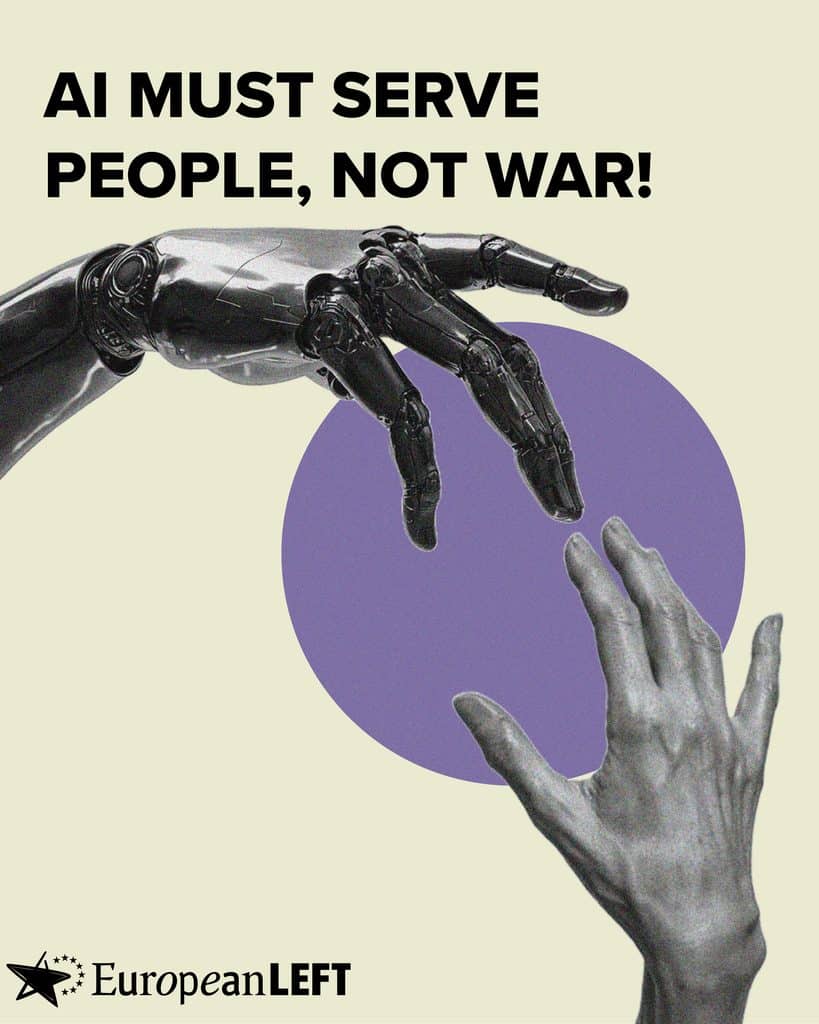
Autonomous weapons can also proliferate, be copied, transferred or captured. Once developed at scale, it becomes increasingly difficult to prevent their spread or guarantee who will ultimately use them.
The European Left has made its fundamental principles clear. Our 2026 Congress has rejected militarisation and the arms race, called for the dismantling of the war economy, defended international law and disarmament, and insisted that technological development must remain under democratic control and serve people rather than military or corporate power. These principles apply with particular urgency when artificial intelligence is incorporated into systems capable of using lethal force.
International concern is rapidly growing as well. In August 2026, the UN Secretary-General and the President of the International Committee of the Red Cross renewed their call for specific international prohibitions and restrictions on autonomous weapons, warning against the autonomous targeting of human beings by machines.
This concern is shared by an overwhelming majority of UN Member States. On 1 December 2025, 164 states voted in favour of UN General Assembly Resolution 80/57 on lethal autonomous weapons systems. Only six voted against it, and the United States was one of them. The resolution warns of the risks of an emerging arms race, escalation, proliferation and the lowering of the threshold for armed conflict, and reaffirms that international law applies to autonomous weapons systems.
At the same time, the United States itself endorsed the 2023 Political Declaration on Responsible Military Use of Artificial Intelligence and Autonomy. That declaration states that military AI must comply with applicable international law and remain within a responsible human chain of command and control.
The Pentagon has also maintained a dedicated policy on autonomous weapons since 2012. Its Directive 3000.09 on Autonomy in Weapon Systems, substantially updated and reissued on 25 January 2023, requires autonomous and semi-autonomous systems to be designed so that commanders and operators can exercise appropriate levels of human judgment over the use of force. It further requires that such systems be developed and used in accordance with the law of war, applicable treaties and rules of engagement.
The creation of AutoWarCom marks a dangerous new step in the institutionalisation of autonomous warfare. It risks normalising increasingly autonomous weapons systems as a permanent and expanding part of military strategy, before clear and binding international safeguards are in place.
The European Left therefore calls for:
- a ban on lethal autonomous weapons capable of killing or harming people without meaningful human control;
- human responsibility and accountability for every decision involving the use of lethal force;
- full compliance with international humanitarian law and international human-rights law;
- a prohibition on integrating AI-enabled autonomous decision-making into weapons of mass destruction, particularly nuclear command, control and launch decisions; and
- urgent negotiations towards a legally binding international instrument establishing enforceable prohibitions and restrictions on autonomous weapons, together with transparency and democratic oversight.
Europe must also confront a serious contradiction in its own AI policy. The EU AI Act explicitly excludes AI systems used exclusively for military, defence or national-security purposes from its scope. This means that one of the areas in which AI can have the most irreversible consequences, the use of lethal force, remains outside the EU’s central AI regulatory framework.
This gap must be addressed. Europe needs binding rules ensuring meaningful human control, human accountability and effective oversight wherever artificial intelligence is used in military systems. AI systems that cannot remain under meaningful human control must not be deployed for decisions involving lethal force.
Artificial intelligence should improve human life, not automate death. Human beings must remain responsible for decisions involving human life, and no state, military or corporation should be permitted to delegate that responsibility to a machin