Sensational Victory of DIE LINKE in Berlin Elections
Author: Heinz Bierbaum, Rosa Luxemburg Foundation.
Berlin Elections: A New Political Landscape
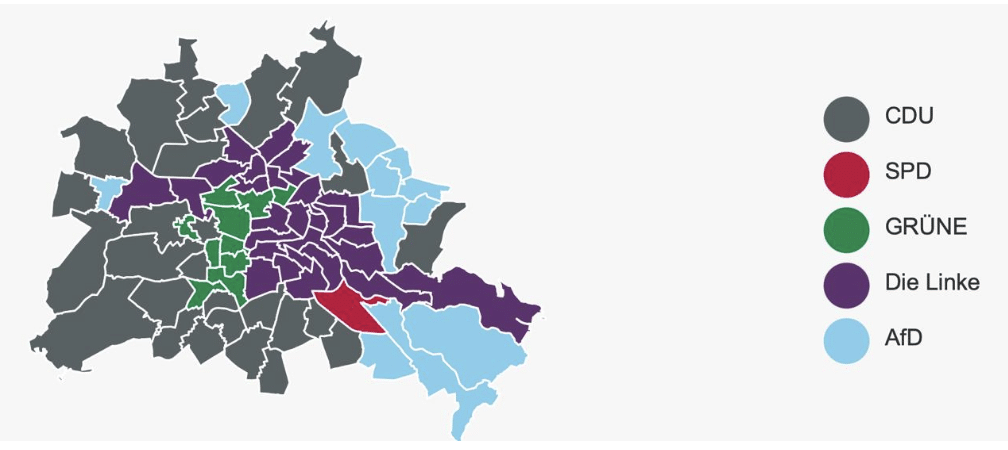
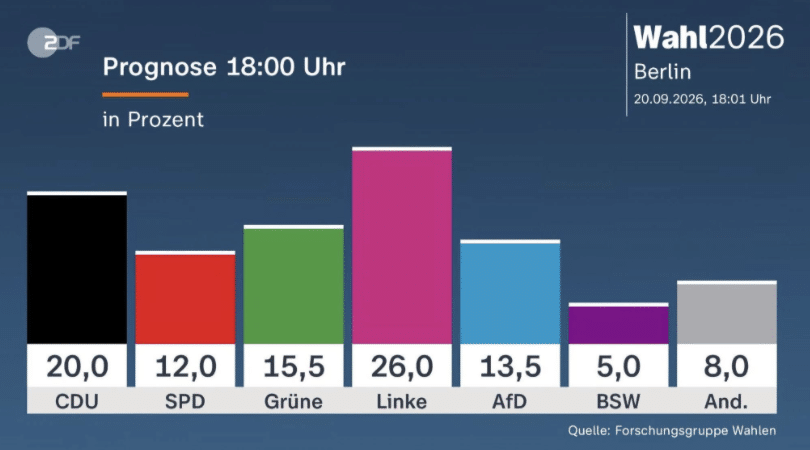
A head-to-head between the CDU (Chancellor Merz’s Christian Democratic Union) and the Die Linke party had been predicted for a long time. In the end, however, the left won with almost 26 percent, while the CDU suffered a major defeat, reaching just 19 percent. The Left more than doubled its votes compared to the last elections. On the other hand, however, the far-right AfD party (Alternative für Deutschland) also gained ground and reached 16 percent . Although the Greens lost something, their result of 14 percent is still remarkable. The SPD (Social Democratic Party) also suffered a serious defeat with only 12 percent – in recent decades it was the first party in Berlin. The Liberals did not enter parliament with only 2.5 percent and no longer play any role in German politics. The BSW, Sahra Wagenknecht’s party, also does not exceed the 5% threshold and is not represented in the city’s parliament
The great success of the Linke is to be attributed to a policy strongly focused on social issues. The central issues were the cost of living, the high cost of energy, very high rents, a degraded public infrastructure. In particular, the housing issue played a central role. Elif Eralp, appointed future mayor of Berlin, has clearly expressed herself in favor of the socialization of large real estate companies.
The victory of the Linke has caused great uproar and criticism, not only among political opponents but also in some sectors of the media. The party is accused of anti-Semitism, an accusation that is however unfounded. In particular, the issue of socialization is the subject of heated debate. The outgoing government, consisting of the CDU and SPD, did nothing to implement the 2021 popular referendum in favor of such socialization. For the Linke, this is a crucial issue without which it is not willing to be part of the future government, which can be formed by a coalition of the Linke, the Greens and the SPD (it is not in favor of this socialization). The formation of a government will therefore be difficult. Numerically, a coalition between the CDU, the Greens and the SPD would also be possible, but it is not likely. If it were to materialize, this would mark the fall of the SPD.
The vote in Berlin is in contrast to that in Mecklenburg-Vorpomerian where the AfD won clearly with 38% (as did the vote two weeks ago in Saxony-Anhalt with as much as 44%), but lacked an absolute majority. The SPD achieved a remarkable result with 35% thanks to an election campaign against the national government. The CDU, on the other hand, collapsed and failed to enter the state parliament, a truly sensational event.
The election results in Berlin, such as those in Mecklenburg-Vorpomerian and Saxony-Anhalt, show that we are facing a new political landscape in Germany. The political center consisting of the CDU, SPD, Greens and Liberals is losing ground. Only the Greens remain stable. The Liberals are disappearing So we can speak of a certain polarization.
The Linke is able to win by focusing on social issues. The urban context is very favorable for the left-wing party, the province is less so. However, the real winning party is the far right. The AfD confirms itself as the most important political force not only in the East but also at the national level.
Undoubtedly, these election results have a strong impact on the government. Despite the disastrous results, Merz immediately declared that he wanted to remain both the party president and the chancellor, receiving support from the party leadership. Nevertheless, the future of this government and in particular of Merz is extremely uncertain.
In this politically very difficult situation, it is clear that no one wants to take Merz’s place. The Social Democrats are faced with a dilemma. As part of the government, they are responsible for a policy that the people reject. If they were to leave the government, which is not very likely, they would be accused of a lack of responsibility towards the country.
If, on the other hand, the government were to continue with these so-called reforms – which are not really reforms but cuts – and with enormous military spending to the detriment of the welfare state and the necessary social-ecological transformation, the AfD would grow further. To combat the rise of the AfD, another policy is needed.
The Linke demonstrated in Berlin that it is possible to win with a strongly oriented approach to social policies. So far, the extreme right is much stronger than the left. It is therefore necessary to build a broader array of progressive and left-wing forces.
The last aspect to be taken into consideration is that yes, the extreme right is very successful among young people, yet it is extremely encouraging that in the Berlin elections the left was the first party among young people: the vast majority of young people voted for the Linke and this remains perhaps the central element of these results.