NON-ALIGNMENT: AN IDEA WHOSE TIME HAS come
ARTICLE BY WALTER BAIER
The Non-Aligned Movement at 65: Why Its Vision of Peace, Sovereignty and Cooperation Matters in an Age of Rearmament and Great-Power Rivalry
As the number of wars grows, along with the danger that they could escalate into a global conflict involving weapons of mass destruction, the idea of non-alignment is once again gaining relevance as an alternative approach to security policy.
In early September, the Non-Aligned Movement marks the 65th anniversary of its founding conference in Belgrade. Convened in 1961 by Yugoslavia’s Josip Broz Tito, India’s Jawaharlal Nehru, Egypt’s Gamal Abdel Nasser and Indonesia’s Sukarno, the conference brought together 25 states. Its founding declaration centred on three major demands – disarmament, decolonisation and reform of the United Nations – that have lost little of their relevance.
Against the arms race
The leaders warned at the time of crises that could lead to world conflict during the transition “from an old order based on domination to a new order based on cooperation between nations”. They criticised existing military blocs for developing into increasingly powerful military, economic and political groupings whose rivalry repeatedly aggravated international relations.
The participants called for general, complete and strictly internationally controlled disarmament and demanded the total prohibition of the production, possession and use of nuclear and thermonuclear weapons.
Decades later, some of these demands found expression in similar form in the Treaty on the Prohibition of Nuclear Weapons, adopted by the UN-general Assembly against the opposition of the nuclear powers and NATO but with strong support from states of the Global South.
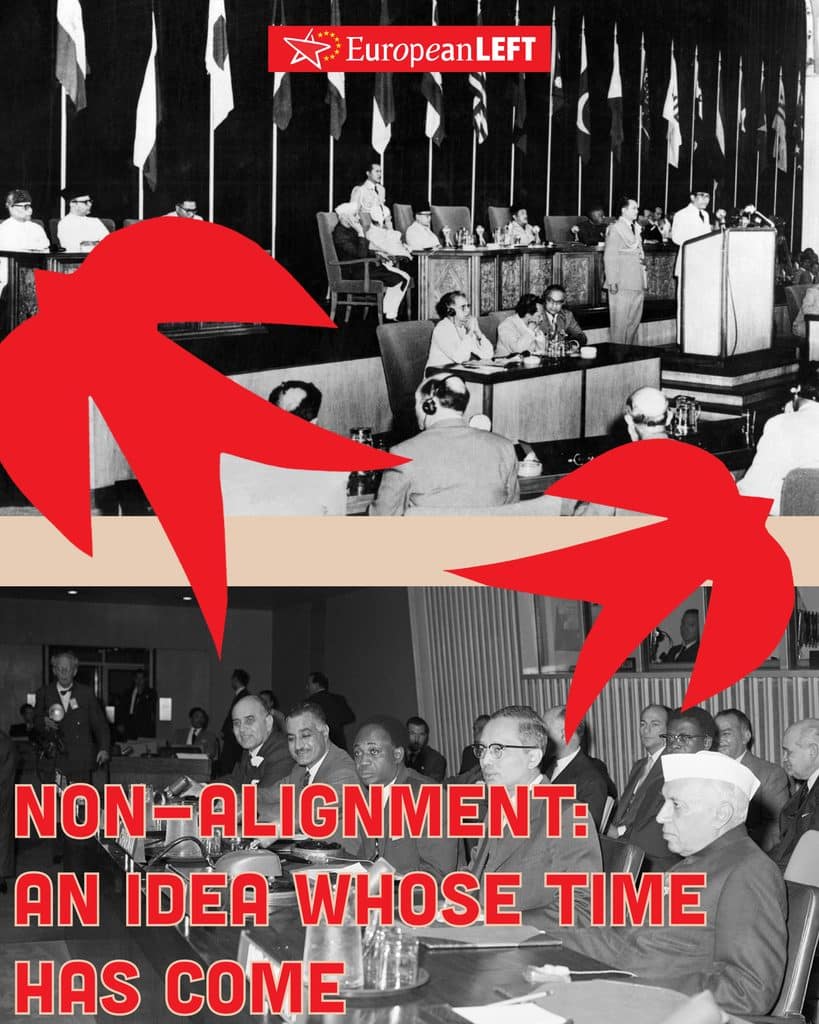
De-colonialization and New International Economic Order
The emergence of the Non-Aligned Movement reflected worldwide concern about the East-West confrontation. Even more importantly, however, it was an expression of the irreversible process of decolonization. The United Nations had 51 member states when it was founded in 1945; by 1961, membership had risen to 99. Today, the UN has 193 members, while the Non-Aligned Movement comprises 120 states.
Its central demand was consequently to eradicate colonialism “in all its manifestations” and to establish peaceful coexistence as a guiding principle of international relations.
Reform of the United Nations, particularly the Security Council, was therefore already on the agenda in 1961. The founding declaration called for the composition of the Council to be brought into line with the expanded membership of the UN. In 1965, the UN Charter was amended and the Security Council enlarged from 11 to 15 members. Yet the privileged position of the five permanent members, including their veto power, remains unresolved to this day.
The Non-Aligned Movement also made a substantial contribution to efforts to prevent a Third World War. In 1963, pressure from countries of the Global South helped bring about the treaty banning nuclear weapons tests in the atmosphere, outer space and underwater. During the period of détente in the 1970s, the movement achieved further successes. In 1974, the UN adopted the Declaration on the Establishment of a New International Economic Order and an accompanying programme of action.
The dividing lines in the struggle for a more equitable global economic order have changed remarkably little since then. When the issue was put to another UN vote in 2024, 51 Western industrialised countries stood opposed to 151 states of the Global South.
Non-alignment, therefore, is far from being merely a historical concept. In the current period of transition in the international order, the Non-Aligned Movement could – and should – once again serve as a point of orientation for those seeking a peaceful and more just future for humanity.