European Left Strengthens Cuba Ties in Havana
Around 1,500 participants from 63 countries attended an international colloquium marking the centenary of Fidel Castro’s birth. A European Left delegation led by EL President Walter Baier met Cuban President Miguel Díaz-Canel and signed a cooperation agreement with the Communist Party of Cuba.
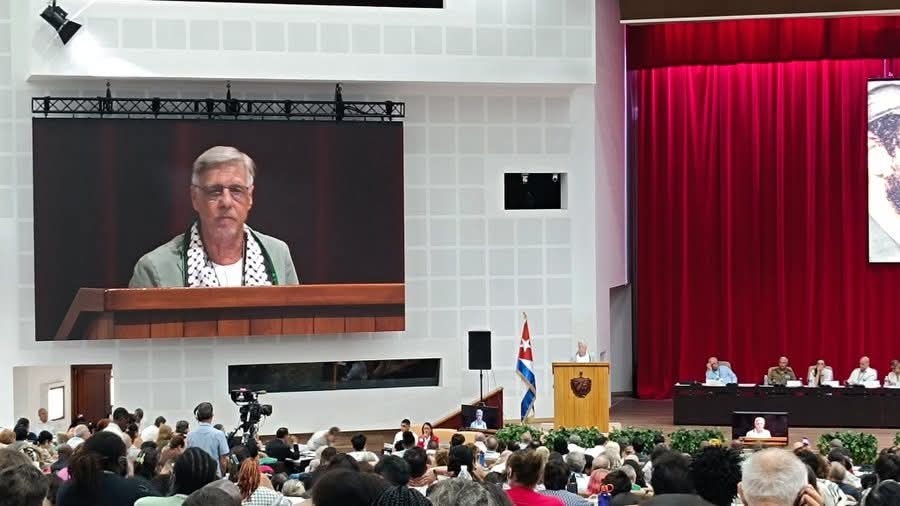
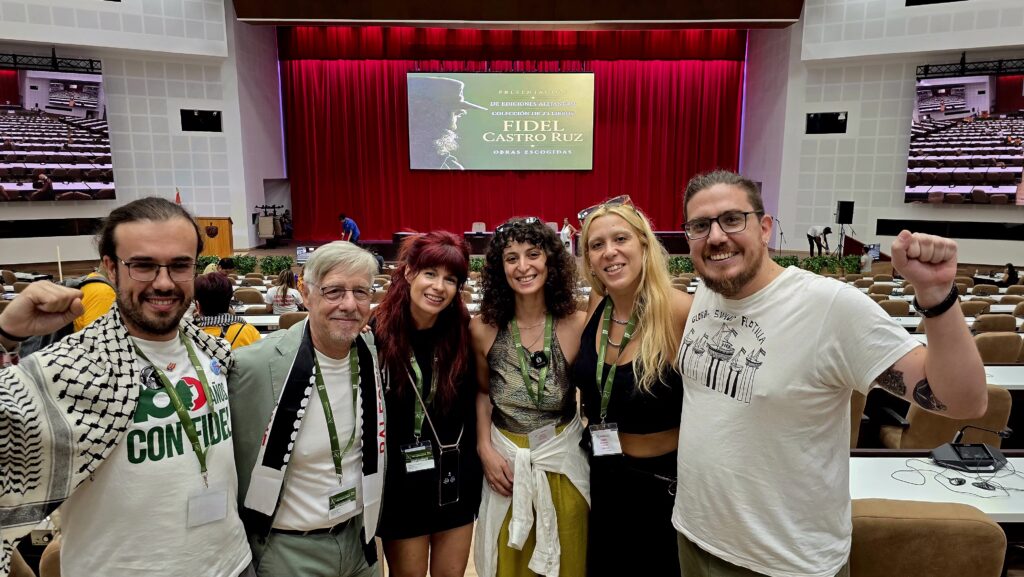
A European Left delegation led by EL President Walter Baier took part in the international colloquium “Fidel: Legacy and Future”, held in Havana from 10 to 12 August. The delegation also included EL Vice-President Marta Martín Morán, responsible for international relations, and political adviser Dagmar Švendová.
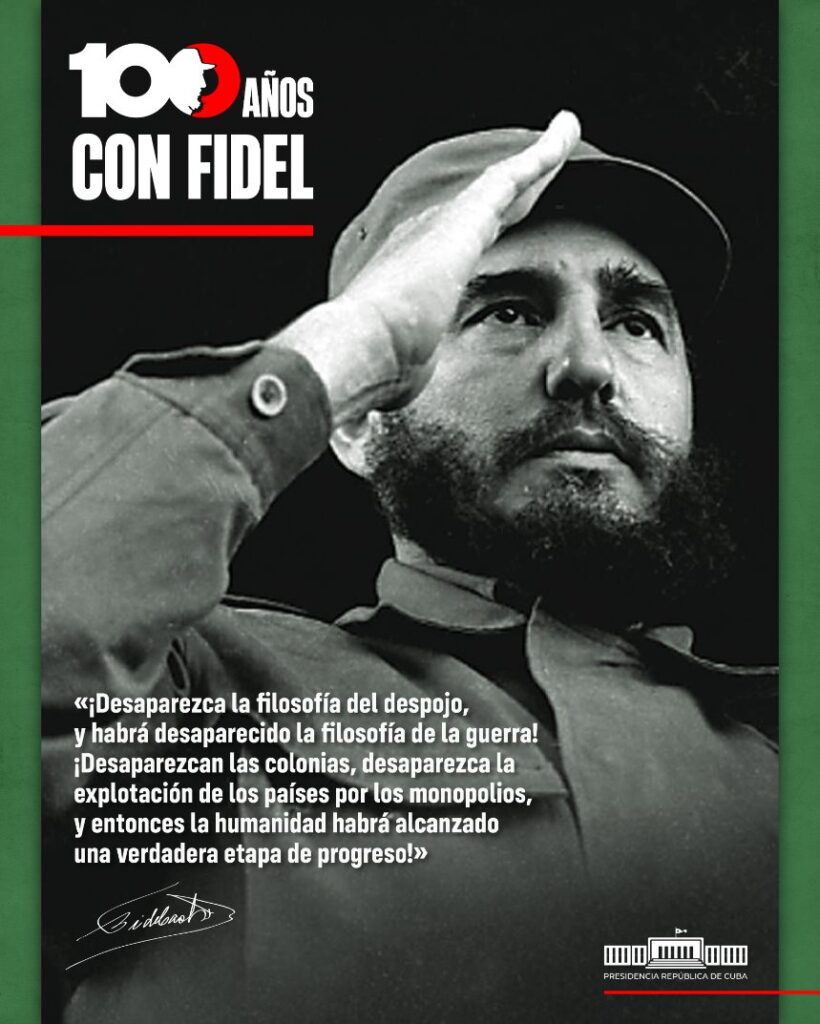
The event marked the centenary of the birth of Fidel Castro Ruz and brought together approximately 1,500 delegates from 63 countries, including representatives of political parties, social movements and solidarity organisations.
The gathering took place amid severe economic and energy difficulties, medicine shortages and the continuing impact of US sanctions. It explored the relationship between Castro’s political legacy, Cuba’s present situation and international solidarity.
The colloquium formed part of a wider anniversary programme that included a ceremony at Havana’s Karl Marx Theatre and a caravan to Birán in eastern Cuba, where Fidel Castro was born on 13 August 1926.
Cuba’s Social Achievements and Present Challenges
The conference opened with a documentary presenting key moments from Castro’s life. The programme focused on his political legacy, the social changes brought about by the Cuban Revolution and Cuba’s international role, particularly in healthcare and its relations with Africa and Latin America.
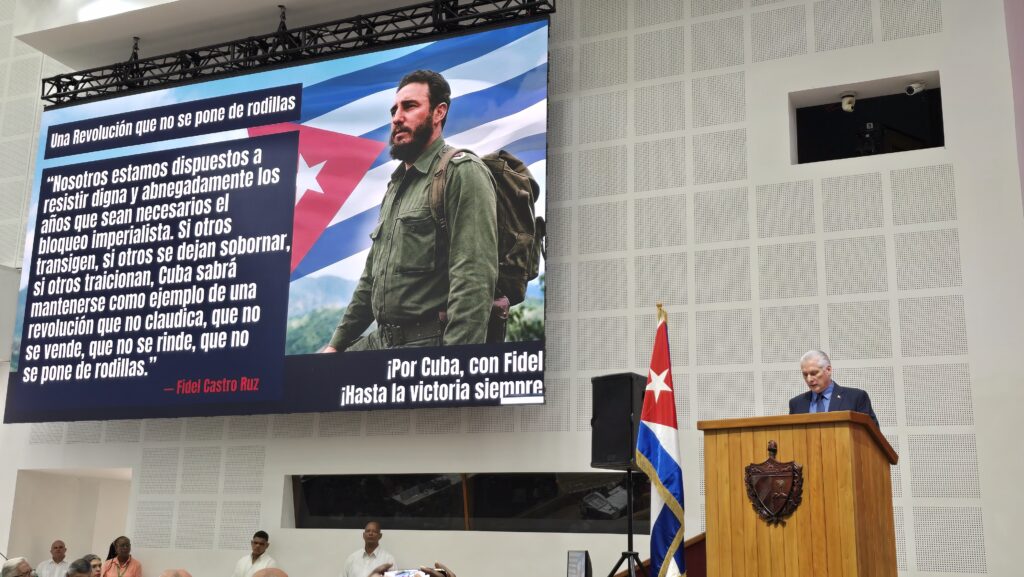
Cuban President and First Secretary of the Communist Party of Cuba Miguel Díaz-Canel described the presence of international guests at a time of severe economic pressure as an act of courage and solidarity.
In his address, he contrasted social conditions before the Revolution with Cuba’s subsequent achievements. He said that 70 per cent of rural schoolchildren had no teachers at the time, while 95 per cent of children suffered from parasitic diseases. Around 46 per cent of the country’s land was controlled by 1.5 per cent of the population and US companies.
Cuba now has a life expectancy of 77.7 years, among the highest in Latin America, and nine doctors per 1,000 inhabitants. Díaz-Canel also highlighted the development of Cuba’s international healthcare cooperation during the 1990s, including the creation of a healthcare programme for Central America and the Caribbean in 1998 and the founding of the Latin American School of Medicine, ELAM, a year later.
He linked current healthcare shortages to the US blockade. According to the figures he presented, 98,500 medically necessary operations cannot currently be performed, Cuba has access to only 30 per cent of the medicines it requires, and approximately 34,000 pregnant women are unable to receive essential prenatal examinations.
Díaz-Canel rejected claims that the country’s economic reforms represented a return to capitalism. He argued that the means of production should remain in the hands of the people while calling for critical reflection on the future of socialism in the 21st century.
“No one here is surrendering; no one is going down on their knees,” he concluded. The audience responded by chanting “No pasarán”, “Yo soy Fidel” and “Cuba sí, bloqueo no”.
Baier: History Is Not Written Only by the Powerful
Addressing the conference on behalf of the European Left’s 40 member and observer parties in 27 countries, Walter Baier described the Cuban Revolution as an event that had transformed his generation’s understanding of the world.
“The Cuban Revolution was proof that history is not written only by the powerful, that courage can defeat despair and dignity can overcome oppression,” Baier said.
Fidel Castro, he argued, refused to accept that the world had to remain as it was and believed in people’s ability to change history. His legacy was therefore not merely a historical memory, but a continuing responsibility to defend peace, justice, sovereignty and human dignity.
A substantial part of Baier’s speech focused on US policy towards Cuba. He described the economic blockade, financial restrictions and pressure on the country’s energy supplies as collective punishment and economic warfare.
“No nation has the right to decide the future of another nation. End the blockade and the energy siege. End the aggression. Respect the sovereignty of Cuba. Let the Cuban people live in peace,” he declared.
Baier placed Cuba’s situation within the broader context of weakening international law, spreading armed conflicts and the future direction of Europe. There could be no lasting security without justice, he argued, and no lasting peace without respect for national sovereignty.
The EL president opposed the rearmament programmes of NATO and the European Union and supported the vision of a more independent, non-aligned and nuclear-weapons-free Europe. The struggle for peace, he said, must become the central focus of European politics.
Baier also called for closer partnerships with the countries of the Global South. Europe should develop relations on equal terms, based on cooperation and solidarity rather than exploitation.
“Unity is our greatest strength. Solidarity is our biggest weapon. Hope is our most powerful motive,” he said.
In conclusion, Baier urged European governments not to remain silent, to reject the US blockade and to work for Cuba’s removal from the US list of state sponsors of terrorism.
“The greatest tribute we can pay to Fidel is not only to remember him, but to continue the struggle for peace, justice, sovereignty and international solidarity,” he concluded.
From Political Commitment to Practical Cooperation
During the colloquium, President Díaz-Canel officially received the European Left delegation. He thanked its members for their long-standing solidarity with Cuba, and both sides expressed their interest in strengthening inter-party relations, political dialogue and cooperation.
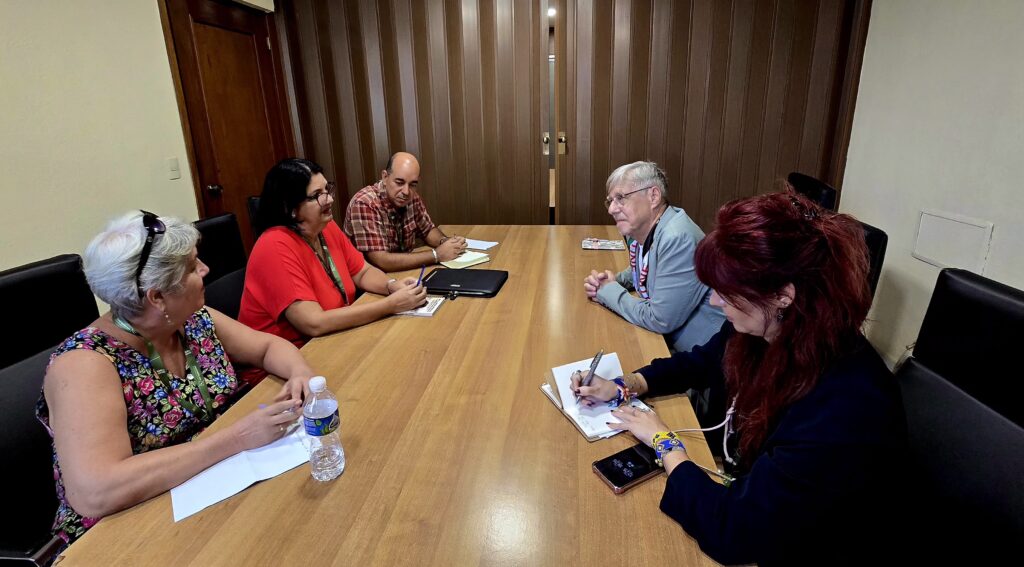
The delegation also met representatives of the Cuban Institute of Friendship with the Peoples (ICAP) and members of international solidarity brigades active in Cuba. Their discussions addressed the consequences of US sanctions and opportunities for closer cooperation between European left-wing organisations and their Cuban partners.
The political talks were followed by the signing of an exchange and cooperation agreement between the Party of the European Left and the Communist Party of Cuba. The document was signed by Walter Baier and Roberto Morales Ojeda, a member of the Political Bureau and Organisation Secretary of the Central Committee of the Communist Party of Cuba.
The agreement is intended to deepen political dialogue, solidarity and cooperation in areas of shared interest. Morales Ojeda proposed developing a concrete roadmap through which both parties could regularly assess progress towards their agreed objectives. Baier stressed the particular importance of unity and cooperation among left-wing forces in the current international situation.
Rather than serving merely as a political declaration, the agreement provides a practical framework for joint initiatives, regular dialogue and long-term cooperation.
International Voices at the Colloquium
Other international speakers highlighted Cuba’s role in anti-colonial struggles, international healthcare and environmental politics.
Namibian Prime Minister Tjitunga Elijah Ngurare recalled Cuba’s contribution to the struggle against colonialism and apartheid in southern Africa. He stressed that southern Africa’s liberation could not be discussed without recognising the role of Fidel Castro and Cuba.
João Pedro Stédile of Brazil’s Landless Workers’ Movement, MST, highlighted Castro’s early warnings about climate change and linked environmental protection to resistance against destructive multinational corporations. A South African delegate also praised the work of Cuban healthcare professionals during the Ebola epidemic.
Solidarity as a Political Commitment
Baier’s speech, the delegation’s meetings and the cooperation agreement build on the common position adopted by the European Left’s member parties. At its 8th Congress in Brussels in April 2026, the party unanimously adopted the resolution “In Defence of Cuba and Against the Blockade Imposed by the USA”.
The resolution calls for an end to the sanctions, respect for Cuban sovereignty and stronger European solidarity with the people of Cuba. The visit to Havana was therefore not only a commemoration of Castro’s centenary, but also a concrete continuation of the commitment adopted by the European Left Congress in April.
While the resolution set out a shared political position, the newly signed agreement provides a practical instrument for implementing it through direct cooperation, regular dialogue and concrete joint activities.
Baier summarised this commitment at the end of his Havana speech: “We will stand with Cuba. Today. Tomorrow. And for as long as it takes.”